The Imperial History of Meng Ding Shan: The Birthplace of Royal Tribute Tea
By SavvyTea | Category: Tea Heritage & Culture
Published on
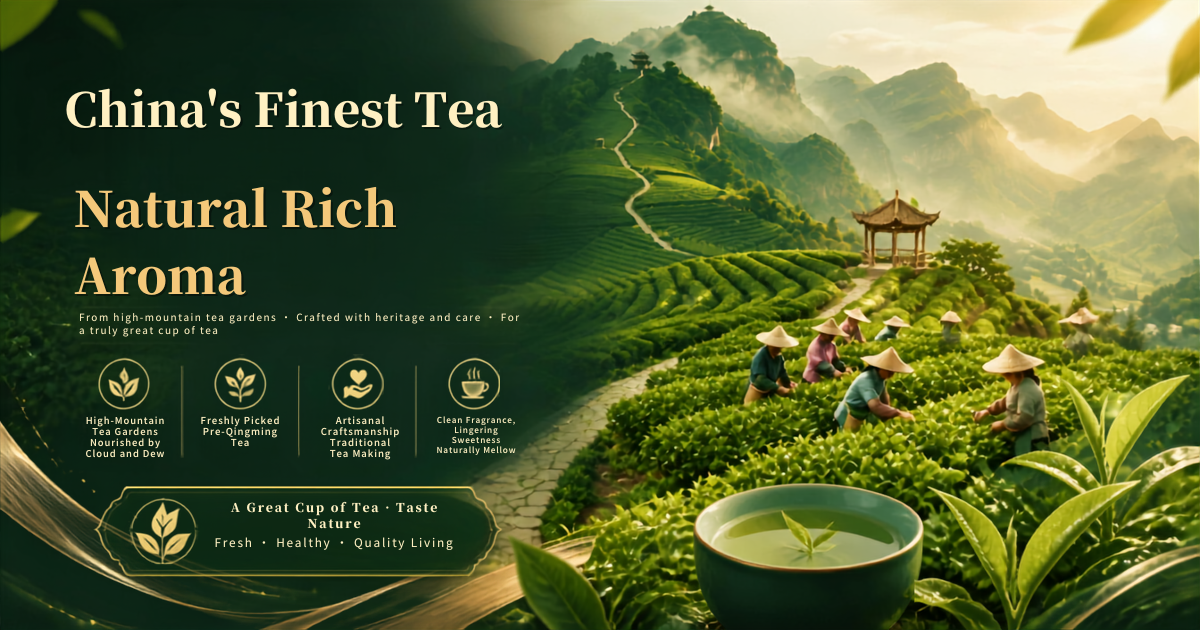
Long before tea became a global daily ritual, it was revered as a sacred botanical, cultivated in the mist-shrouded peaks of Southwestern China. At the heart of this ancient tradition stands Meng Ding Shan (Mount Mengding) in Sichuan Province—a location celebrated by tea historians and connoisseurs as a true cradle of world tea culture.
To understand the refined elegance of SavvyTea’s signature Mengding Ganlu, one must journey back over two millennia into the mist, legend, and imperial prestige of this sacred mountain.
The Cradle of World Tea Culture
Situated in Ya'an, Sichuan, Meng Ding Shan rises above rich, humid valleys shrouded in perpetual fog and gentle rainfall. This unique microclimate creates optimal conditions for slow-growing, nutrient-dense tea buds rich in natural sweetness and amino acids.
It was here, during the Western Han Dynasty (around 53 BC), that a legendary master named Wu LiZhen planted seven wild tea trees on the mountain's summit. This act is widely recognized as the earliest documented intentional cultivation of tea by human hands. Unlike wild foraging, Wu LiZhen’s garden marked the transition of tea from a wild medicinal forage to a carefully nurtured art form.
Over centuries, monks, scholars, and tea artisans continued to refine cultivation techniques on Meng Ding Shan. Temples were built, rituals formed, and tea became intertwined with spiritual practice. The mountain’s slopes evolved into a living museum of ancient horticulture—each terrace carrying the imprint of generations who treated tea not merely as a crop, but as a cultural treasure.
The Legacy of Royal Tribute Tea (贡茶)
By the Tang Dynasty (618–907 AD), the extraordinary quality of Meng Ding Shan tea reached the imperial court in Chang'an. Impressed by its delicate aroma and sweet aftertaste, the Emperor designated tea from Mount Mengding as an official Imperial Tribute Tea (Gong Cha, 贡茶).
For over 1,000 years—spanning the Tang, Song, Yuan, Ming, and Qing dynasties—the finest early spring buds gathered from Meng Ding Shan were reserved exclusively for the royal family and sacred court rituals. Historic texts often declared:
"Of all the teas under Heaven, Yangzi River water is the finest, and Mengding Mountain tea is the supreme."
Every spring, imperial envoys traveled to Sichuan to oversee the painstaking harvesting process. Only the tightest, most pristine buds were selected, processed by master artisans, and transported along royal routes directly to the Forbidden City.
The Tribute Tea system was more than a symbol of luxury—it was a political and cultural institution. Tea from Meng Ding Shan became a diplomatic gift, a ceremonial offering, and a marker of imperial refinement. Its reputation shaped the development of Chinese tea culture, influencing how tea was judged, appreciated, and celebrated across the empire.
Crafting "Sweet Dew": The Art Behind Mengding Ganlu
The name Mengding Ganlu translates literally to "Sweet Dew of Mengding Mountain." Inspired by Buddhist and Taoist traditions, "sweet dew" signifies celestial nectar—a beverage capable of renewing mind and spirit.
To achieve its imperial standards, the craft relies on precise artisan techniques passed down through generations:
- First Flush Harvesting: Plucked exclusively in early spring, selecting only tender single buds or one-leaf-one-bud sets.
- Three-Time Kneading & Roasting: A specialized processing technique involving repeated light rolling and pan-firing, which curls the leaves into fine, jade-green spirals coated in silver down.
- Subtle Umami & Floral Notes: The resulting brew yields a pale, glowing liquor free of harsh bitterness, delivering a silky texture with hints of toasted chestnut, fresh spring greens, and a long-lasting sweet finish.
Even today, tea masters on Meng Ding Shan follow traditional methods with remarkable devotion. Many families have been crafting Ganlu for centuries, preserving the same gentle hand movements, roasting rhythms, and sensory intuition that once produced tea for emperors.
Meng Ding Shan: A Living Heritage Site
Modern visitors to Meng Ding Shan often describe the mountain as a place where time slows. Ancient stone paths wind through terraced gardens, temple bells echo across the valleys, and the air carries a soft sweetness from the surrounding forests.
The region is now recognized as a World Tea Culture Heritage Site, attracting scholars, tea enthusiasts, and cultural historians from around the globe. Its legacy is not merely preserved—it continues to evolve, inspiring new generations of tea artisans and connoisseurs.
For those who seek authenticity, Meng Ding Shan remains one of the few places where tea is still grown, harvested, and crafted in harmony with centuries-old tradition.
Bringing Imperial Quality to Your Cup
At SavvyTea, we believe every cup of loose-leaf tea should be a journey through history and craftsmanship. By sourcing our green tea directly from authentic high-altitude gardens on Meng Ding Shan, we preserve the timeless standards once reserved for emperors.
Our Mengding Ganlu is crafted with the same reverence and precision that defined its imperial legacy. Each sip reflects the mountain’s unique terroir—its mist, its mineral-rich soil, and its centuries of artisanal wisdom.
Whether enjoyed as a pristine green tea or delicately scented with fresh blossoms in our Mengding Ganlu Jasmine Green Tea, this historic leaf offers a rare glimpse into the authentic origins of Chinese tea heritage.