Mengding Ganlu: The Story, the Science, and the Craft Behind China’s Most Elegant Green Tea
Published on
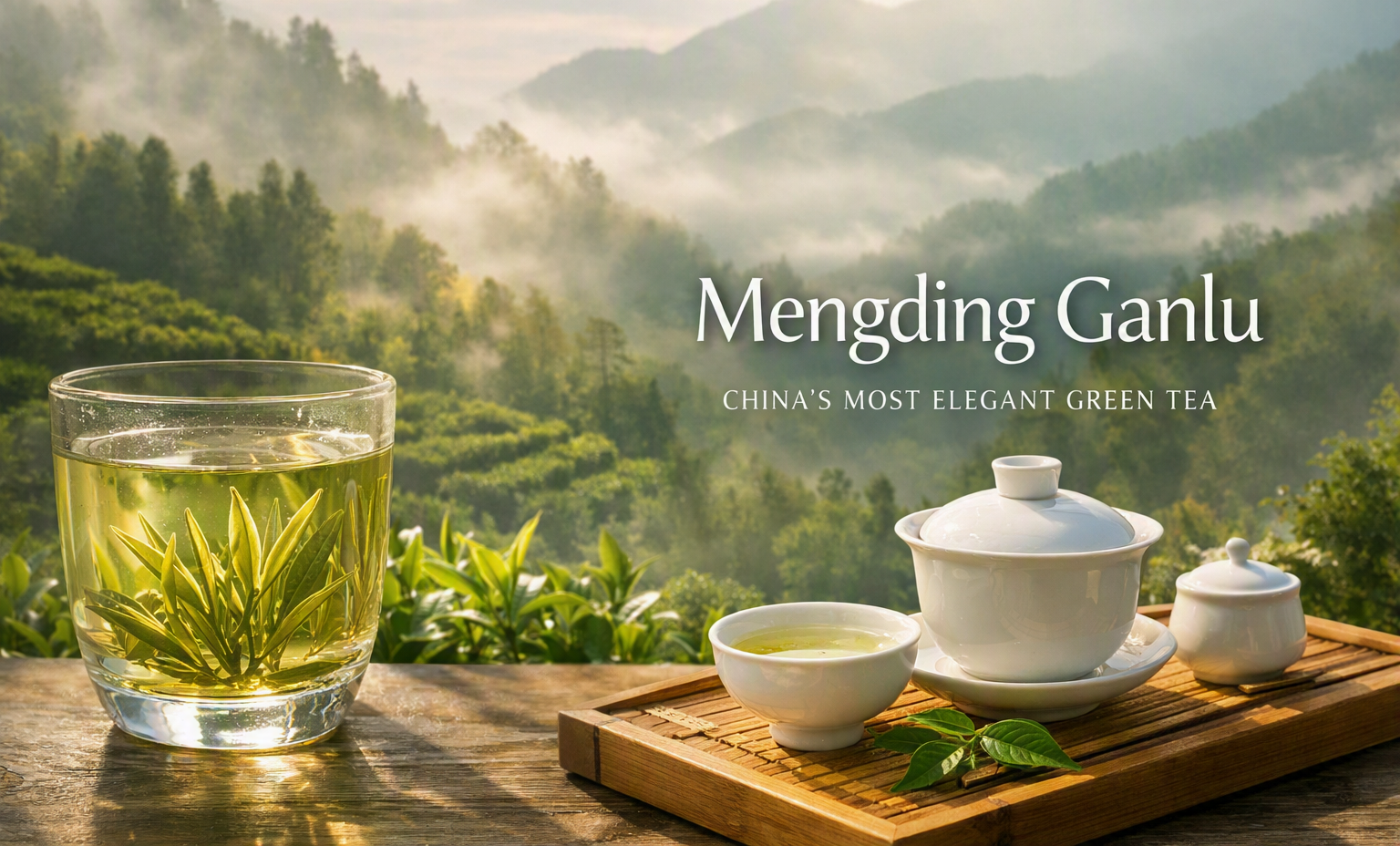
When tea lovers discuss the pinnacle of Chinese green tea, names like West Lake Longjing or Biluochun often dominate the conversation. However, tucked away in the misty, cloud-shrouded peaks of Sichuan Province lies the birthplace of cultivated tea itself. Here, Mount Mengding produces Mengding Ganlu (Meng Mountain Sweet Dew), arguably the most elegant, historic, and chemically fascinating green tea in the world.
Translated literally as "Sweet Dew," Mengding Ganlu offers an ethereal drinking experience characterized by a velvety texture, a striking pale jade infusion, and a lingering sweetness. To truly appreciate this tea, one must understand the legendary narrative, the unique environmental science, and the rigorous craftsmanship that shape every single leaf.
The Story: The Cradle of Tea Cultivation
Mengding Ganlu carries a historical pedigree that few other agricultural products can match. According to Chinese records, it was on Mount Mengding during the Western Han Dynasty (around 53 BC) that a Daoist master named Wu Lizhen first planted seven domestic tea trees. This marks the earliest documented evidence of systematic tea cultivation in human history.
By the Tang Dynasty, the exceptional quality of Mount Mengding's harvest caught the attention of the imperial court. The tea was elevated to the status of Tribute Tea, reserved exclusively for emperors and sacred ancestral rituals. Mengding Ganlu became synonymous with spiritual purity and intellectual refinement, frequently praised in the verses of legendary poets like Bai Juyi.
"Of water, the Yangtze River is the finest; of tea, Mount Mengding is the supreme." — Ancient Chinese Proverb
The Science: Terroir and Phytochemistry
The exceptional elegance of Mengding Ganlu is not an accident of history; it is a direct result of distinct environmental conditions and complex biochemistry.
Mount Mengding rises sharply above the Sichuan Basin, creating a unique microclimate characterized by perpetual mist, high humidity, and over 2,000 millimetres of annual rainfall. The sun rarely pierces directly through the heavy cloud cover. This natural shading functions exactly like modern agricultural shade-cloths, triggering profound biochemical adaptations in the tea plants:
- Suppressed Catechins: Limited sunlight slows down the conversion of L-theanine into polyphenols (catechins). Because catechins are responsible for bitterness and astringency, Mengding Ganlu maintains an incredibly smooth, non-bitter profile.
- Elevated L-Theanine: Retained in high quantities due to the mist, this amino acid crosses the blood-brain barrier in humans to promote relaxed alertness. In the cup, it delivers the rich, savory "umami" flavour and deep sweetness that gives the tea its "Sweet Dew" moniker.
- High Chlorophyll Content: To capture the scarce sunlight, the leaves overproduce chlorophyll, giving the dry leaves their vibrant, deep green hue and the brewed liquor its luminous pale-jade clarity.
The Craft: Shaping the Sweet Dew
Even with perfect history and chemistry, transforming raw leaves into Mengding Ganlu requires breathtaking human skill. Harvested exclusively in early spring, workers pick only the tenderest first buds. It takes tens of thousands of individual hand-plucked buds to produce just a single kilogram of finished tea.
The processing technique is a masterclass in temperature control and manual agility, requiring three distinct phases of fixation and rolling:
- Shaqing (Kill-Green): The freshly plucked buds are tossed by hand in a hot wok. This rapid heating deactivates the enzymes responsible for oxidation, locking in the tea's green colour and fresh, vegetal chemical profile.
- San-Chao San-Rou (Three Roasts, Three Rolls): This is the signature technique of Ganlu. The tea is repeatedly roasted gently and hand-rolled on bamboo mats. This intricate, exhausting cycle breaks the cell walls of the leaves just enough to release essential oils, while gradually coaxing the delicate buds into tightly furled, slender strips.
- Baking and Pelleting: The final drying phase uses lower heat to preserve the delicate silver down (trichomes) covering the young buds. These hairs create a frosted appearance on the dry leaf and float like tiny crystals in the brewed infusion, contributing to the signature silky mouthfeel.
Experiencing Mengding Ganlu
To enjoy Mengding Ganlu to its fullest potential, treat it with the same gentleness used to create it.
Use filtered water cooled to approximately 80°C to 85°C (176°F to 185°F) to avoid scalding the delicate amino acids.
Glass or high-quality porcelain vessels are ideal, allowing you to watch the silver-fuzzed green buds dance and unfurl in the water.
With its deep roots in the dawn of tea culture, its climate-driven sweetness, and its meticulously handmade form,
Mengding Ganlu is more than just a beverage. It is a living, drinkable artifact of human harmony with nature.